An accessible unit is a different footprint from a standard one, and that footprint drives every decision. Where a standard portable toilet fits in about 4 square feet of ground, an ADA unit needs a level pad closer to…
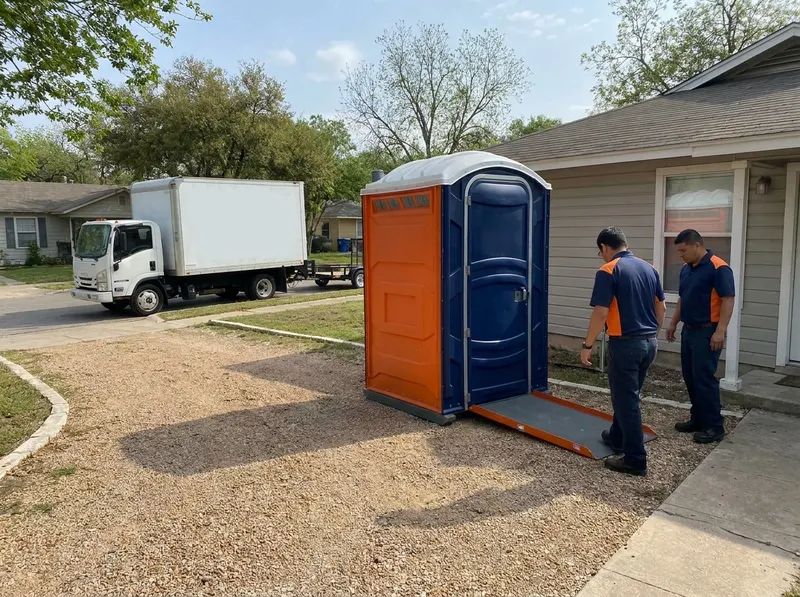
An accessible unit is a different footprint from a standard one, and that footprint drives every decision. Where a standard portable toilet fits in about 4 square feet of ground, an ADA unit needs a level pad closer to 5 feet by 5 feet plus swing room for the door and a firm, step-free path leading to it. Level ground is not a preference on an accessible unit — a tilted floor makes the interior unusable for a wheelchair. That rules out the caliche slopes and gravel berms plenty of San Antonio job sites default to, so we look for a driveway apron, a slab, a compacted pad, or flat turf. Our truck also needs to get within roughly 10 feet of the placement spot with overhead clearance, which is worth talking through before delivery day in the older parts of town.
Choose the accessible unit when the public will use it. Festivals, fun runs, church and school events, park gatherings at Woodlawn Lake Park or Brackenridge Park, block parties in Monte Vista, and anything permitted through the City of San Antonio should plan on at least one accessible unit per cluster of toilets — commonly cited guidance is 5% of units with a minimum of one, and your permit office is the final word on what they want to see. On construction sites, supers around Alamo Ranch and Westover Hills often add one accessible unit alongside standard units so the site works for every trade and for inspectors walking the job. Choose standard units instead when the site is crew-only, access is tight, and nobody on the job needs step-free entry — they cost less, fit in narrower spots, and you can put more of them where the work actually is. The trade-off is simple: the accessible unit costs more and demands better ground, and it is the only one that serves a guest or worker using a wheelchair, walker, or cane.
Placement in San Antonio's older neighborhoods takes a minute of planning. King William and Lavaca have narrow streets, tight alleys and mature live oaks with low limbs, so we usually stage an accessible unit at the flat end of a driveway or a curb cut rather than back behind the house. Southtown and Government Hill sites often have a level sidewalk apron that works well. Stone Oak and Alamo Ranch typically have room to spare, but new construction there means loose fill dirt — we look for the closest compacted surface. Event grounds like Hemisfair near the Tower of the Americas, and the lots serving the AT&T Center and Freeman Coliseum, are mostly paved, which makes accessible placement straightforward as long as we know where pedestrian routes run.
Texas heat is what separates a clean accessible unit from a complaint. An ADA unit has more interior volume and more surfaces people touch — handrails, the door pull, the seat — so we wipe those down at every service, not just pump the tank. In July and August we push for a shaded placement where one exists, and on hot-weather events or busy job sites we recommend stepping up service frequency rather than stretching a weekly schedule. Extra servicing is priced up front, before delivery, so it never shows up as a surprise line item. Same with delivery, pickup and long-term rental fees — you get the all-in figure when you book. Call (830) 381-4759 with your dates and your placement spot, and we will tell you straight whether an accessible unit fits there.
Every job gets a firm, written price after a free on-site visit.
Tell us about your ada-accessible portable toilet rental job in San Antonio and we'll send a clear, written quote — usually the same day.
 SmartChoice Potty Solutions